Everything you need to write a coherent book with AI
FireQuill is not a prompt box. It is a full long-form writing system: a living story bible, specialist editors that flag (never overwrite) your prose, and generation that remembers your characters, continuity, and voice from chapter one to the end.
A character who actually changes.
Who your protagonist is in chapter thirty is not who she was in chapter one — and the book knows the difference.
As you write, FireQuill keeps up with your characters. Someone learns a thing they didn’t know. A friendship cools. A voice hardens over twenty chapters the way a real one would. The engine notices, and asks you before it writes any of it down — nothing about your cast changes unless you say so. Look back at any point in the book and you’ll find who they were there.
For non-fiction the same idea becomes an Expert Panel: the specialists behind your argument, each with their own way of seeing the problem, ready to be drafted as, argued with, and cited.
Talk to your characters. Consult your panel.
Stress-test dialogue with your protagonist. Ask your contrarian expert to demolish your central argument. Every voice in your book becomes a reachable collaborator.
Open the Cast tab in the editor and pick a character. They reply as them — as whoever they have become by this point in the book, not as a summary of who they started out as. Test a piece of dialogue before you commit it. Throw a hypothetical at your antagonist and watch the reaction. Workshop a confrontation scene from the inside.
Non-fiction’s Panel tab does the same with experts. Pick the contrarian on your panel and ask them to find the weakest claim in your latest section. Now your “kill your darlings” pass has muscle.
A roster of specialist editors, on demand.
Not one model trying to be every kind of editor at once. A desk of them, each built for one job.
Most AI editors are a single generalist with a long prompt, which is why their feedback sounds like a book report. Ours are built and calibrated one at a time: the one reading your sentences isn’t trying to spot plot holes, and the one watching your plot has no opinion about your commas.
They flag; they never rewrite you. Notes arrive in an inbox and wait for you — accept one, put it off, or throw it out. Nothing touches your prose on its own, and nothing you have already said no to comes back to ask again.
Structure
Whether the chapter earns its place: pacing, momentum, the setups that have to pay off later.
Sentence craft
Diction, rhythm, dead verbs, the tics you stopped seeing about forty thousand words ago.
Consistency
What your people know, where things are, when things happened. The errors nobody catches in their own book.
Evidence & argument
Whether a claim is carried by what sits under it — and where a fair-minded reader would push back.
And they tell you how much it matters — a repeated word and a broken promise to the reader are not the same note, and you should never have to read them as though they were. Not “great chapter, consider tightening pacing.”
The book’s bones, in fifteen minutes.
What kind of book it is. What happens. Who it happens to. What it’s about underneath. Settled before you write a word, and yours to change whenever you like.
Most platforms ask you to “describe your story” and start generating. FireQuill makes you do the structural work first, and makes it elegant rather than a chore — the questions a good editor would ask you over coffee, asked in an order that builds.
Or use Holistic Setup: type a one-sentence pitch like “Mystery: a detective returns to her hometown to investigate a missing teen and uncovers her own buried family secret.” FireQuill drafts the whole bible from it — the shape, the people, the themes — and hands it to you to argue with. You review. You edit. Locked fields stay yours.
FireQuill is built on the bet that the work of writing is structural design, not typing. We make you do the design work, all of it, before the typing starts. The agent isn’t replacing the craft. It’s amplifying it.
Write 80,000 words while you sleep.
Auto-Flow writes your book chapter by chapter, checks its own work as it goes, and stops to ask when it needs you. You wake up to a draft.
Start the run and go to bed. Each chapter is written against the book you designed, then read back by the editors before it is allowed to stand. Chapters that need another pass get one. When something needs a decision only you can make, the run stops and emails you instead of guessing.
Everything lands in your manuscript, and you can roll back a chapter or the whole run. A cost ceiling stops runaway spend, so an unattended draft can never become an unattended bill.
Direct your book like a film.
Auto-generate paragraph by paragraph and pause at every creative fork. The agent offers three to four directions; you pick the one that lands. Or write your own.
Auto-flow generation is unattended; Director’s Mode is the opposite: maximum agency. It writes until the story reaches a real decision, then stops and shows you where it could go — each direction written out far enough, and in voice enough, that you can tell how it would feel. Sarah confronts him in the rain. Sarah lets him walk away, and follows. Sarah’s brother arrives, changing the calculus.
You pick. The book commits. Or type your own direction in plain English and the agent honors it. Repeat fork by fork.
Every word in your draft traces back to a decision you made. You stay the author. The agent stays the typist.
One engine. Six ways to build a book.
Fiction and non-fiction carry the deepest machinery: a character engine or an expert panel, and the full editorial desk. Podcast, documentary, game, and musical each get a format-aware wizard and a generator tuned to how that form is actually built. Same engine. Different bones.
Most platforms bolt non-fiction on as an afterthought and stop there. FireQuill was track-aware from the first day, and the track list kept growing. Pick your form at the wizard’s first step and everything downstream reshapes around it — what it calls things, what it asks you, what it watches for, and where the finished thing can go.
The two flagship tracks carry the full agentic depth. The four newer tracks share the wizard, the generation pipeline, and the export suite, tuned to their form. The vocabulary changes; the care doesn’t.
For novelists.
The deepest track: a living cast, the full editorial desk, and a wizard that thinks in story.
- A cast that grows with the book
- Plot that still holds together at chapter thirty
- The small contradictions that survive every re-read
- Structure and sentence craft, read separately
- Cast Chat: workshop dialogue from the inside
For arguers.
Built for argument: the panel behind your claims, and editors who read like reviewers.
- An expert panel standing behind your argument
- Claims weighed against what sits under them
- Written for the reader you actually have
- Research sources: ground chapters in your own PDFs
- Panel Chat: stress-test claims with your experts
For hosts.
Conversational, narrative, or solo. The format is the first fork, and it reshapes everything.
- Format-aware wizard: host, guest, or narrator roles
- Structured episode beats, not loose prose
- Transcript or narration-script layout
- Episode scripts, ready to record
For truth-tellers.
Subject, filmmaker, and the discipline of access. Real-world story, sourced.
- Subject + filmmaker point of view
- Truth & access: sourcing and chronology rigor
- AV two-column screenplay output
- Fountain / Final Draft / PDF export
For world-runners.
Branching narrative with a coherent story state that survives player choice.
- Structure-aware: linear, branching, or anthology
- Story-state cast across every path
- Canonical-path script from a branching design
- Screenplay-format export
For composers.
Songs and book, plotted together. The libretto and the score, in step.
- Tradition-aware song placement + diegesis
- Character and song list built from the bible
- Print-ready libretto (PDF)
- Editable libretto (Word) for collaborators
And any finished project, in any track, can be adapted into a screenplay: type-aware craft for fiction, non-fiction, documentary, game, or musical sources, exported to Fountain, Final Draft, or PDF.
Everything around the words.
The manuscript is the center. The studio does the rest: faces for your cast, sources under your claims, and a shelf of export formats for wherever the book goes next.
Cast Portraits
Generate portraits for every character and expert: five art styles, three variants each, set your favorite as the avatar. Free to try; included on every paid plan.
Research Grounding
Upload your PDFs, docs, and notes. Non-fiction chapters draft from retrieved passages, so claims stay anchored to your own sources, not the model’s memory.
Ten Export Formats
Markdown, Word, EPUB, KDP-ready EPUB, and print PDF, plus Fountain, Final Draft, and libretto formats for screen and stage. Stable, exportable, yours forever.
Where books become productions.
FireQuill doesn’t stop at prose. Five dedicated workstations take the same story bible into casting, worldbuilding, screen, air, and audio.
Your characters, under contract.
The roster view of character-first: every character and expert you own, with their credits, followers, and voice. Forge new ones, send them into books, and watch their record grow — roles stack up the way credits stack on an actor’s résumé.
A universe your books share.
Places, ages, peoples, powers — built once in a dedicated worldbuilding workstation, then compiled straight into any project’s story bible. Write three books in the same world and the rules hold in all three.
From manuscript to screen.
Adapt a finished book scene by scene — you approve the cut list before a page is drafted — or write an original script from your outline. Industry-standard formatting, hand-edited lines that survive a re-adapt, and Fountain, Final Draft, and PDF export.
Put your story on air.
Import a podcast project as a show, cast its voices from your roster, and lay out every episode segment by segment. Casting and show setup are live today; full episode generation is rolling out.
Your book, read aloud.
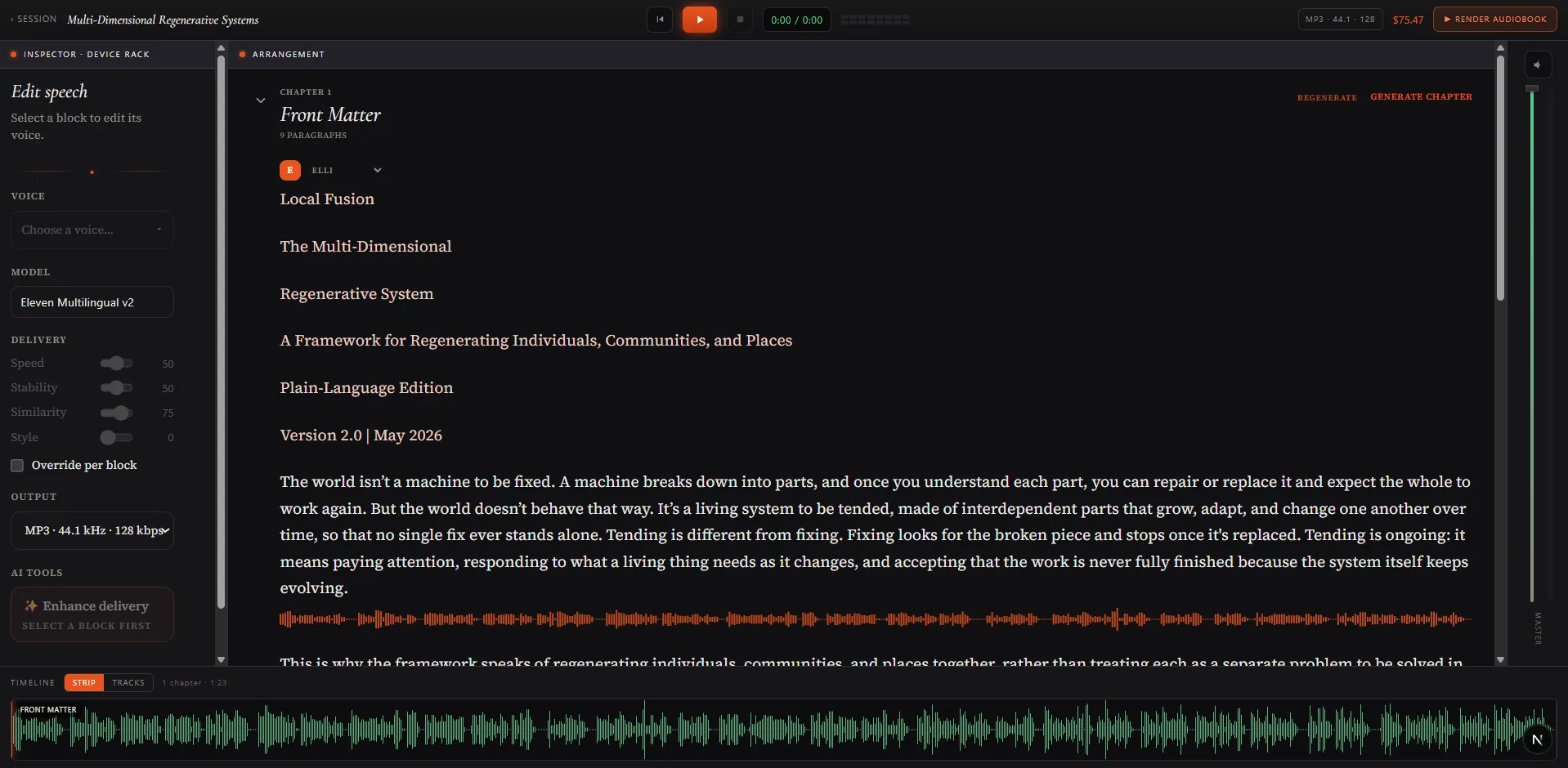
A full DAW workstation for narration: cast a voice, tune delivery block by block, scrub the waveform timeline, and render the whole book straight to MP3. No separate tool, no export dance.
Build your book the way it’s actually built: as a system.
Sign-up takes thirty seconds. The wizard takes fifteen minutes. The first chapter takes an hour, or a night, or however long the work of writing actually takes.
Start Writing for Free →